指数搜索(Exponential Search)算法又称为双倍搜索(Doubling Search)算法或是蔓延搜索(Galloping Search)算法,是二元搜索(Binary Search)算法的变体。这套算法可以在已排序好的串行中进行高效率的搜索,要搜索的元素在串行中愈前面的话,搜索性能愈好。
指数搜索法(Exponential Search)
指数搜索法的概念
指数搜索法是基于二元搜索法的算法,如果您还不了解二元搜索法的话,请先参考这篇文章:
指数搜索法与二元搜索法的差异在于,它在一开始的时候,并不是直接去选择串行中间的元素来比较,而是先去比较索引值为 20 = 1 的元素。如果发现要查找的元素比索引值为 20 的元素还要小,表示要查找的元素不是在索引值 0 的位置上,要不然就是不在串行中;如果要查找的元素比索引值为 20 的元素还要大,表示要查找的元素可能会出现在索引值为 20 之后,此时再继续比较要查找的元素与索引值为 20 + i = 2i 的元素,i 为 1, 2, 3, ...。如果在 i 迭代的过程中发现该索引值对应的元素比要查找的元素还要大时,就可以用二元搜索法来搜索索引值 2i - 1 + 1 ~ 2i - 1 的范围中,是否有我们要查找的元素;如果串行是有限的,且在 i 迭代的过程中找不到比要查找的元素还要大的元素,则可以直接用二元搜索法来搜索索引值 2i - 1 + 1 ~ 串行长度 - 1 的范围。
指数搜索法的过程
假设现在有个已排序好的整数数组,内容如下:
索引    0   1   2   3   4   5   6   7   8   9
数值    2   9  30  32  38  47  61  69  79  81
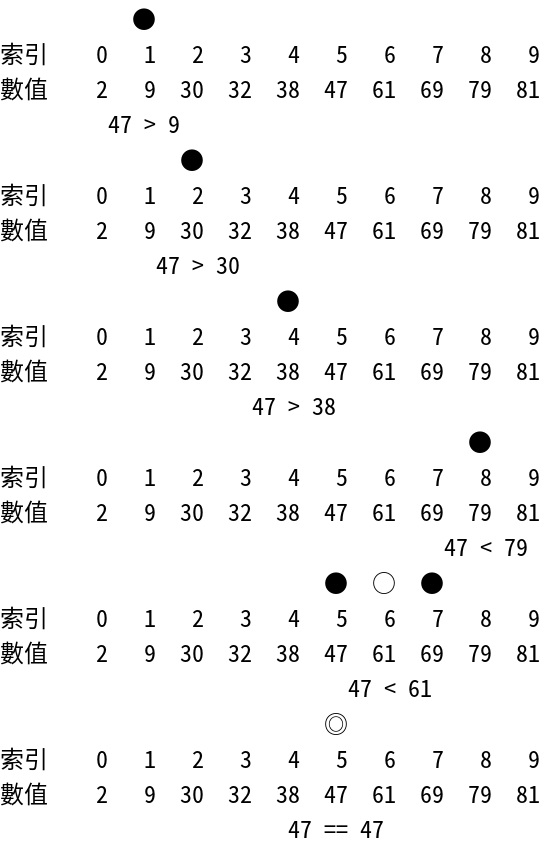
然后我们要用指数搜索法来找到元素 47。一开始先比较索引值为 20 = 1 的元素和要查找的元素 47 的大小。
           ●
索引    0   1   2   3   4   5   6   7   8   9
数值    2   9  30  32  38  47  61  69  79  81
         47 > 9
由于查找的元素 47 比索引值为 20 = 1 的元素 9 还要大,因此继续与索引值为 2i + 1 = 20 + 1 = 21 = 2 的元素做比较。
               ●
索引    0   1   2   3   4   5   6   7   8   9
数值    2   9  30  32  38  47  61  69  79  81
             47 > 30
由于查找的元素 47 比索引值为 21 = 2 的元素 30 还要大,因此继续与索引值为 2i + 1 = 21 + 1 = 22 = 4 的元素做比较。
                       ●
索引    0   1   2   3   4   5   6   7   8   9
数值    2   9  30  32  38  47  61  69  79  81
                     47 > 38
由于查找的元素 47 比索引值为 22 = 4 的元素 38 还要大,因此继续与索引值为 2i + 1 = 22 + 1 = 23 = 8 的元素做比较。
                                       ●
索引    0   1   2   3   4   5   6   7   8   9
数值    2   9  30  32  38  47  61  69  79  81
                                     47 < 79
由于查找的元素 47 比索引值为 23 = 8 的元素 79 还要小,因此我们可以知道如果查找的元素 47 要存在于该串行中的话,其索引值必定会在 22 + 1 ~ 23 - 1 的范围中,也就是 5 ~ 7。接着再针对这个范围做二元搜索法即可。
                           ●  ○  ●
索引    0   1   2   3   4   5   6   7   8   9
数值    2   9  30  32  38  47  61  69  79  81
                             47 < 61

                           ◎
索引    0   1   2   3   4   5   6   7   8   9
数值    2   9  30  32  38  47  61  69  79  81
                        47 == 47
如此一来便可以发现元素 47 存在串行中索引值为 5 的位置。若要搜索的元素在串行中愈前面的话,就可以愈快被搜索到。
指数搜索法的程序实作
/// 指数搜索法。
pub fn exponential_search(array: &[i32], target_element: i32) -> Option<usize> {
    let length = array.len();

    if length == 0 {
        None
    } else if target_element == array[0] {
        Some(0)
    } else {
        let mut two = 1;

        while two < length {
            match target_element.cmp(&array[two]) {
                Ordering::Equal => {
                    return Some(two);
                }
                Ordering::Less => {
                    return binary_search(array, target_element, (two >> 1) + 1, two - 1);
                }
                Ordering::Greater => {
                    two <<= 1;
                }
            }
        }

        binary_search(array, target_element, (two >> 1) + 1, length - 1)
    }
}

/// 二元搜索法,使用循环来迭代。
pub fn binary_search(array: &[i32], target_element: i32, mut start: usize, mut end: usize) -> Option<usize> {
    while end >= start {
        let middle = start + ((end - start) >> 1);

        match target_element.cmp(&array[middle]) {
            Ordering::Equal => {
                return Some(middle);
            }
            Ordering::Greater => {
                start = middle + 1;
            }
            Ordering::Less => {
                if middle > 0 {
                    end = middle - 1;
                } else {
                    break;
                }
            }
        }
    }

    None
}
/**
 * 指数搜索法。
 */
public static int exponentialSearch(final int[] array, final int targetElement) {
    final int length = array.length;

    if (length == 0) {
        return -1;
    }

    if (targetElement == array[0]) {
        return 0;
    }

    int two = 1;

    while (two < length) {
        if (targetElement == array[two]) {
            return two;
        } else if (targetElement < array[two]) {
            return binarySearch(array, targetElement, (two >> 1) + 1, two - 1);
        }

        two <<= 1;
    }

    return binarySearch(array, targetElement, (two >> 1) + 1, length - 1);
}

/**
 * 二元搜索法,使用循环来迭代。
 */
public static int binarySearch(final int[] array, final int targetElement, int start, int end) {
    while (end >= start) {
        final int middle = (end + start) >>> 1;

        if (targetElement == array[middle]) {
            return middle;
        } else if (targetElement > array[middle]) {
            start = middle + 1;
        } else {
            end = middle - 1;
        }
    }

    return -1;
}
/**
 * 指数搜索法。
 */
function exponentialSearch(array: number[], targetElement: number) {
    const length = array.length;

    if (length === 0) {
        return -1;
    }

    if (targetElement === array[0]) {
        return 0;
    }

    let two = 1;

    while (two < length) {
        if (targetElement === array[two]) {
            return two;
        } else if (targetElement < array[two]) {
            return binarySearch(array, targetElement, (two >> 1) + 1, two - 1);
        }

        two <<= 1;
    }

    return binarySearch(array, targetElement, (two >> 1) + 1, length - 1);
}

/**
 * 二元搜索法,使用循环来迭代。
 */
function binarySearch(array: number[], targetElement: number, start: number, end: number) {
    while (end >= start) {
        const middle = start + ((end - start) >> 1);

        if (targetElement === array[middle]) {
            return middle;
        } else if (targetElement > array[middle]) {
            start = middle + 1;
        } else {
            end = middle - 1;
        }
    }

    return -1;
}
// 指数搜索法。
func ExponentialSearch(array []int, targetElement int) int {
	length := len(array)

	if length == 0 {
		return -1
	}

	if targetElement == array[0] {
		return 0
	}

	two := 1

	for two < length {
		if targetElement == array[two] {
			return two
		} else if targetElement < array[two] {
			return BinarySearch(array, targetElement, (two>>1)+1, two-1)
		}

		two <<= 1
	}

	return BinarySearch(array, targetElement, (two>>1)+1, length-1)
}

// 二元搜索法,使用循环来迭代。
func BinarySearch(array []int, targetElement int, start int, end int) int {
	for end >= start {
		middle := int(uint(end+start) >> 1)

		if targetElement == array[middle] {
			return middle
		} else if targetElement > array[middle] {
			start = middle + 1
		} else {
			end = middle - 1
		}
	}

	return -1
}
左位移一个比特等同于「乘以 2」;右位移一个比特等同于「除以 2」。
指数搜索法的复杂度
以 #{{n}}# 来表示要搜索的数据笔数。
| 项目 |
值 |
备注 |
| 最差时间复杂度 |
#{{O(\log n)}}# |
|
| 最佳时间复杂度 |
#{{O(1)}}# |
要查找的元素刚好位于串行的最前面。 |
| 平均时间复杂度 |
#{{O(\log n)}}# |
|
| 最差空间复杂度(递归的二元搜索法) |
#{{O(\log n)}}# |
|
| 最差空间复杂度(迭代的二元搜索法) |
#{{O(1)}}# |
|